Most articles on this topic hand you a list and stop. The list is the easy part. Knowing why each item is on it tells you which of three problems you have: a document that genuinely cannot be signed electronically, one that can be signed under a different rule, or one that can be signed today and examined much more closely later. Only the first is a hard stop.
"Cannot be signed electronically" is almost always the wrong question
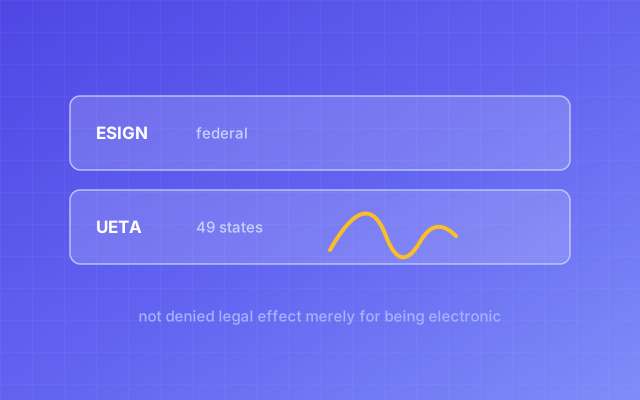
The right question is which law is doing the work. ESIGN does one narrow, powerful thing: it says a signature, contract or record cannot be denied legal effect solely because it is electronic. That is 15 U.S.C. §7001(a). It is a rule against a specific objection, not a license that switches document types on and off.
So when §7003 says ESIGN "shall not apply" to a category, it withdraws that federal protection. It does not say the document is invalid if signed electronically. It says ESIGN will not be the reason it is valid. The governing law then answers on its own terms: some categories are effectively closed, some have their own electronic statute, and some are open with extra formality attached.
Getting this wrong costs money both ways. Read an exclusion as a ban and you courier documents that never needed printing. Read it as nothing and you end up with an unenforceable instrument.
An ESIGN exclusion removes a federal protection. It does not create a federal prohibition.
RunwayDue
ESIGN §7003 is the actual list, and it has two halves
Subsection (a) excludes records to the extent they are governed by three bodies of law: For what ESIGN does reach, and what makes a signature enforceable there, see is an electronic signature legally binding in the US.
- §7003(a)(1): any rule of law governing the creation and execution of wills, codicils or testamentary trusts.
- §7003(a)(2): any state rule of law governing adoption, divorce or other matters of family law.
- §7003(a)(3): the Uniform Commercial Code as in effect in any state, other than former §1-107, former §1-206, and Articles 2 and 2A.
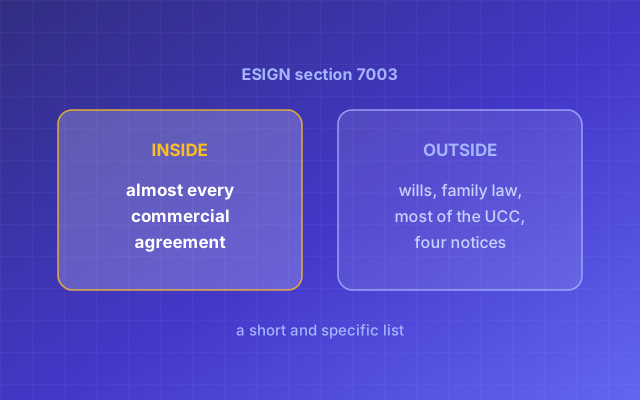
Subsection (b) excludes documents outright, and it has three paragraphs, not six items, which is what you will find when you look it up. Paragraph (b)(1) covers court orders and notices and official court documents, including briefs and pleadings. Paragraph (b)(2) covers four kinds of notice: (A) cancellation or termination of utility services; (B) default, acceleration, repossession, foreclosure, eviction or the right to cure under a credit agreement secured by, or a rental agreement for, an individual's primary residence; (C) cancellation or termination of health or life insurance benefits, excluding annuities; and (D) recall of a product, or material failure of a product, that risks endangering health or safety. Paragraph (b)(3) covers documents required to accompany the transportation or handling of hazardous materials, pesticides, or other toxic or dangerous materials.
That is the whole list. Anything not on it, and not restricted by a state statute or a regulator, is inside ESIGN: MSAs, statements of work, NDAs, proposals and purchase orders.
Wills are excluded because the signer cannot be asked
The reason is not technological suspicion. A will is the only major legal document whose author is guaranteed to be unavailable when it is read. Every other contract has a living counterparty who can be deposed or simply telephoned. A will is proved after the testator's death, so the execution formalities carry the evidentiary load themselves: a writing, the signature, two witnesses present at the same time, sometimes a self-proving affidavit. They substitute for testimony that will never exist.
ESIGN steps back and lets each state decide whether an electronic process can carry that load. A minority have decided it can, and two separate things happened there that get confused. States wrote their own electronic wills statutes first: Nevada was earliest, with NRS 133.085 enacted in 2001, then Indiana and Arizona in 2018 (Arizona's effective in 2019), then Florida, whose Electronic Wills Act was signed in June 2019 and took effect on January 1, 2020. Separately and later, the Uniform Law Commission approved the Uniform Electronic Wills Act in 2019, and Utah was the first state to adopt it. The two groups are not the same set of states, and the conditions attached differ between them.
Everywhere else the answer is still paper, wet ink and witnesses in the room. Send the client to an estate attorney in their own state: a will that fails on execution fails completely, and nobody finds out in time to fix it.
Family law is excluded to leave the question to the states, not to ban electronic signing
This is the exclusion most often misreported. Section 7003(a)(2) does not say you cannot electronically sign a separation agreement. It says ESIGN does not override state rules of law governing adoption, divorce and other family matters.
State law and local court rules decide instead, and they are not uniform. Some family courts accept electronically signed settlement agreements as a matter of course. Others require original signatures, notarization, or the agreement recited on the record. Ask the court clerk or the attorney handling the matter rather than extrapolating from another state.
Most of the UCC sits outside ESIGN, and the promissory note is where it bites
Articles 2 and 2A stay in. Everything else in the UCC is out. Article 2 covers the sale of goods and Article 2A leases of goods, and §7003(a)(3) preserves both, so purchase orders, equipment leases and sales contracts are ordinary electronic signing work. Articles 3, 4, 4A, 5, 7, 8 and 9 are outside, which pulls in negotiable instruments, funds transfers, letters of credit, documents of title, investment securities and secured transactions.
The reason is not about signatures at all. A negotiable instrument is not evidence of a debt, it is the debt. Whoever holds the original paper has the right to be paid, and possession of that unique object is what stops the same note being sold to three buyers. An electronic file has no original: copying it is free and perfect. The property that makes electronic documents useful everywhere else is what breaks a negotiable instrument.
Congress answered with a separate mechanism rather than by loosening §7003. Under ESIGN §7021 an electronic record can be a "transferable record" if it would be a note under UCC Article 3 in writing, the issuer expressly agrees it is one, it relates to a loan secured by real property, and a system reliably establishes a single authoritative copy that is unique, identifiable, unalterable and under an identified party's control. UETA §16 does the same job at state level, without the real-property limit.
Under ESIGN, an electronic promissory note is valid because a system proves there is only one of it, not because someone signed it electronically.
RunwayDue
That is a system-level requirement, not a signature-level one. Standard e-signature tooling, RunwayDue's included, does not make a transferable record. It produces a signed PDF and a certificate of completion, the right output for a services contract and the wrong one for an eNote. Originating notes needs an eVault and a registry, a different category of product.
Court documents and the four notices are excluded for reasons of delivery, not of consent
Court filings are excluded because courts govern their own procedure. The notices are excluded because Congress wanted bad news to arrive by a method the law already specifies.
The court exclusion sounds restrictive and is in practice the opposite. In federal civil cases, Fed. R. Civ. P. 5(d)(3)(A) requires a person represented by an attorney to file electronically unless a local rule allows or requires otherwise, or the court allows nonelectronic filing for good cause, paired with a conformed signature convention such as /s/ Jane Smith tied to the filer's login credentials. Section 7003(b)(1) keeps ESIGN out of the way so those rules can operate. Read the rules of the specific court rather than generalizing from another one.
The four notice exclusions in §7003(b)(2) share a different logic. Each removes something a person depends on, or warns them of danger: your power is being cut off, your home is being foreclosed, your coverage is ending, this product could hurt you. The concern was not that an electronic signature is unreliable. It was that an emailed notice can land in a spam folder, go to a stale address, or reach an account the person no longer opens.
Each of those four exclusions attaches to the notice, not to the contract behind it. A residential lease can be signed electronically; the eviction notice under it cannot rely on ESIGN. Annuities are carved back in, and the exclusion reaches only an individual's primary residence.
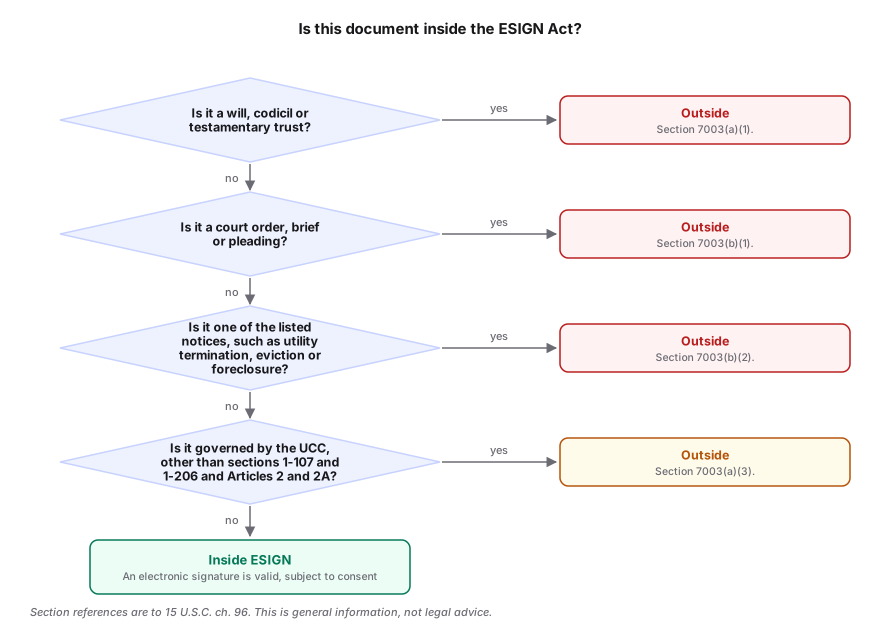
Every category, its real status, and what to do instead
"Outside" below means the federal validity rule does not apply, which is not the same as prohibited. Where a document is fine to sign, e-signature is what does it here.
| Category | Status under ESIGN | What to do instead |
|---|---|---|
| Wills, codicils, testamentary trusts | Outside (§7003(a)(1)) | Paper, wet ink and witnesses, unless the state has an electronic wills act |
| Adoption, divorce, other family law | Outside (§7003(a)(2)) | Ask the specific court or the attorney of record first; the rules differ by county |
| UCC Articles 3, 4, 4A, 5, 7, 8, 9 | Outside (§7003(a)(3)) | A transferable record system for notes; paper for the rest |
| UCC Articles 2 and 2A | Inside, expressly preserved | Sign electronically as normal |
| Court orders, notices, pleadings, briefs | Outside (§7003(b)(1)) | Follow the court's local rules and its conformed-signature convention |
| Utility, primary-residence foreclosure or eviction, insurance cancellation and product recall notices | Outside (§7003(b)(2)(A) to (D)) | Serve the notice by the statutory method; the contract behind it can still be signed electronically, and annuities are carved back in |
| Hazardous materials shipping documents | Outside (§7003(b)(3)) | Follow the DOT and EPA documentation rules, pesticides included |
| Business contracts, MSAs, SOWs, NDAs, proposals | Inside | Sign electronically, with a consumer consent step if a consumer is involved |
The second tier is evidentiary: you can sign it, but a court will look harder
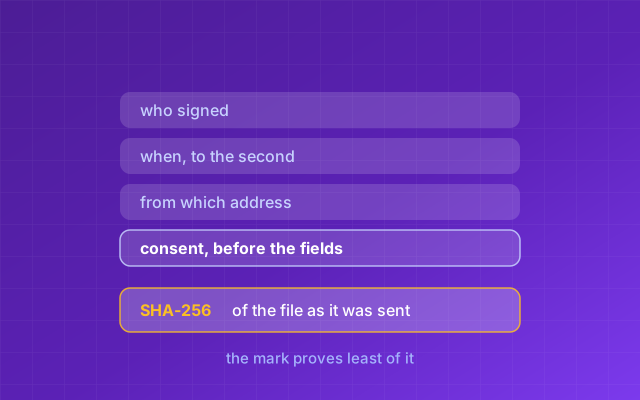
For documents inside ESIGN, the fight is never about whether electronic signatures are legal. It is about whether this signature was made by this person. UETA and ESIGN leave attribution to ordinary evidence law: a signature is attributable to a person if it can be shown to be the act of that person, and the showing can be made in any manner. That phrase, "any manner", is the whole game. A cursive-looking name typed on a PDF gives you nothing to show. A record holding the recipient's own unique link, the second they opened it, the address they opened it from, and a consent step recorded before any field could be filled gives you a great deal. Notarization is the one add-on worth flagging: §7001(g) allows an electronic notarial act, but state notary law controls the act itself.
California's appellate courts have refused to enforce electronically signed arbitration agreements where the employer could not authenticate the signature. In Ruiz v. Moss Bros. Auto Group, Inc., 232 Cal. App. 4th 836 (2014), the employer's declaration asserted that the employee had signed but did not explain how the signing process worked or how the signature was linked to him, and the court held the agreement was not authenticated. In Bannister v. Marinidence Opco, LLC, 64 Cal. App. 5th 541 (2021), the trial court found the employee had not signed at all, on evidence that an HR representative had access to the onboarding account. Neither case turned on the signature being electronic. Both turned on who could be proved to have made the mark.
The case that catches the most people is a record a statute requires be given to a consumer in writing. Section 7001(c) permits electronic delivery only after consent given in a way that reasonably demonstrates the consumer can access the format, following a clear statement of their right to paper, how to withdraw consent, and the hardware and software required. Skip that and you have a compliance failure even though the signature is valid.
Five questions that tell a prohibition from a higher evidentiary bar
Run these in order. Most documents resolve at the first or second.
- Which law requires a signature here at all? If the answer is "the contract does, and no statute is involved", you are inside ESIGN and the analysis is over. That covers most business paperwork.
- Is the document itself excluded, or only a notice about it? Section 7003(b)(2) excludes notices, not the agreements behind them. Do not let an excluded notice contaminate a signable contract.
- Does a state statute put it back in? ESIGN yields to state law in the excluded categories, and state law sometimes says yes. Electronic wills acts are the clearest example.
- Will the dispute be about validity or about attribution? For anything inside ESIGN, assume attribution, and ask what you would hand a judge to prove who signed.
- Does the document need to be a unique, controllable original? If yes, you need a transferable record system, not a signing tool. Notes, drafts and documents of title are the cases; everything else is fine as a signed PDF.
What a record has to hold if it is going to survive the harder look
Four things, and a typed name in a script font is none of them. Each of the four is taken apart in what an e-signature audit trail actually has to contain.
Consent captured before anything else. Consent has to be recorded before the signer can fill a single field, because consent obtained afterwards proves nothing about what they agreed to at the time. RunwayDue blocks field entry until consent is recorded, and writes it to the event log as its own event.
Identity evidence tied to each signer separately. One shared link for three signers is one piece of evidence for three claims. Per-recipient tokens mean each person's link is their own, so a forwarded email cannot become somebody else's signature. RunwayDue generates each link from the operating system's cryptographic random number generator.
A timeline nobody can quietly revise. Sent, opened, viewed, consented, signed, declined, each with a timestamp to the second including the timezone, plus the IP address and user agent at the moment of signing, written as things happened.
Proof the document did not change. Be precise here, because this is where most explanations go wrong. RunwayDue's certificate prints one hash, labeled Original SHA-256: the hash of the original file that was uploaded and sent out for signature. That supports one check, and it is the useful one. Hash the original document you were sent, compare it to the value on the certificate, and if they match, that document is byte for byte the file that went into signing. Hashing the finished, stamped PDF against that value will never match, and is not meant to: the signed copy is a different file, and no PDF can contain its own hash. The signed copy's own SHA-256 is kept on the file record, and the event log shows its first 16 characters, enough to tie a copy to an event and not enough to verify a file.
RunwayDue appends the consent record, the recipient detail, the event log and that original hash to the finished PDF, so the record travels with the document: you can hand it to a bank, a buyer or a court without also handing them a login to your software. What the certificate does not do is reach a legal conclusion for you. It records what happened, and no more.
None of this is legal advice, and RunwayDue is not a law firm. If a document falls in a §7003 category, or you are not sure whether it does, ask a lawyer licensed in the relevant state before you send it anywhere.
Frequently asked questions
Is it illegal to sign a will electronically in the United States?
Not illegal, but in most states it will not produce a valid will. Section 7003(a)(1) withdraws federal support, so the state's execution formalities decide, and most still require a physical writing signed before two witnesses. A minority allow it, under a statute of their own such as Nevada's NRS 133.085, or by adopting the Uniform Electronic Wills Act.
Can a divorce settlement be signed electronically?
Sometimes, depending on the state and the court. Section 7003(a)(2) leaves adoption, divorce and other family law matters to state rules, so there is no national answer. Some family courts accept electronically signed settlement agreements routinely; others require original signatures or notarization.
Can a promissory note be electronic?
Only as a transferable record, which is a system requirement rather than a signature one. ESIGN §7021 requires that the record would be a note under UCC Article 3 if written, that the issuer expressly agrees it is one, that it relates to a loan secured by real property, and that a system reliably establishes a single authoritative copy under an identified party's control. Ordinary e-signature software does not do this.
Does the eviction notice exclusion mean I cannot sign a lease electronically?
No. The exclusion in §7003(b)(2)(B) attaches to the notice, not to the lease, so you can sign a residential lease electronically. What you cannot do is rely on ESIGN to deliver the eviction, foreclosure, default or right-to-cure notice under it, and it covers only an individual's primary residence.
Which state has not adopted UETA?
New York is the only one. It never enacted UETA and uses its own Electronic Signatures and Records Act, in the New York State Technology Law, which reaches a similar result by a different route. Illinois adopted UETA in 2021, so any list naming Illinois as a holdout is out of date.
Can an electronically signed document be notarized?
Yes. Section 7001(g) satisfies a notarization, acknowledgement, verification or oath requirement if the electronic signature of the authorized person, with all other legally required information, is attached to or logically associated with the record. What ESIGN does not do is authorize remote online notarization; whether the notary can be on a video call is state law.
What makes an electronic signature hard to challenge in court?
Evidence of attribution, not the signature graphic. The strongest records show consent captured before any field could be filled, a unique link issued to that one recipient, a timestamp to the second with timezone for each event, and the IP address and user agent at signing.
Are court filings excluded because courts distrust electronic signatures?
No, the opposite. Section 7003(b)(1) keeps ESIGN out of the way so courts can govern their own procedure. In federal civil cases, Fed. R. Civ. P. 5(d)(3)(A) requires a person represented by an attorney to file electronically unless a local rule allows or requires otherwise, or the court allows nonelectronic filing for good cause, with a conformed signature tied to the filer's credentials.
Does ESIGN apply to consumer contracts?
Yes, with an extra step. Where a statute requires a record to be provided to a consumer in writing, §7001(c) allows electronic delivery only after the consumer affirmatively consents in a manner reasonably demonstrating they can access the format, having first received a statement of their right to paper, how to withdraw consent, and the hardware and software required.