- No United States statute prescribes what an ordinary commercial invoice between private parties must contain, so most "required field" lists describe convention, not law. The exceptions are narrow: customs entries and federal contracts.
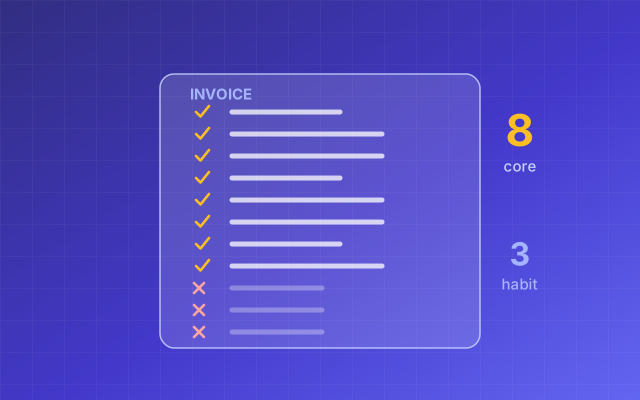
- Eight fields do the real work: your legal name and address, the client's legal name and billing address, a unique invoice number, an issue date, a due date, an itemized description with amounts, the total due, and how to pay.
- A consecutive, gap-free invoice number series is worth more than any other single field, and not because US law requires one. It does not. A gap you cannot explain is a hole in your own records.
- Printing sales tax on an invoice is arithmetic; deciding whether you owe sales tax is a separate legal question about nexus and taxability that no invoice template answers.
- For payments made after December 31, 2025, the Form 1099-NEC and 1099-MISC reporting threshold rose from $600 to $2,000 under section 70433 of the One Big Beautiful Bill Act (P.L. 119-21), so expect fewer forms and rely on your own records.
- The IRS says to keep records supporting an item of income or a deduction for 3 years in the ordinary case, and 6 years if you failed to report income amounting to more than 25 percent of the gross income shown on your return.
No general federal law tells you what a US invoice must contain
There is no United States statute setting out the contents of a commercial invoice for services between private parties. That is the honest starting point, and it surprises people who have worked under other regimes. The European Union's VAT Directive lists mandatory invoice particulars in Article 226. The United Kingdom requires a set list of particulars on a VAT invoice under regulation 14 of the VAT Regulations 1995. The United States has no equivalent for a freelancer billing a client in the next state.
Two federal rules do prescribe invoice contents, and both are narrow.
One is a customs rule. Under 19 C.F.R. §141.86, an invoice covering imported merchandise must show the port of entry, the parties and the date of sale, a detailed description of the goods, and the quantities either in the weights and measures of the country or place the goods were shipped from, or in US weights and measures. That is about physical goods crossing a border, not about a consultant billing a US client for forty hours of work.
The other is federal contracting, and this one can reach a small business. If you invoice a federal agency, FAR 52.232-25(a)(3) (48 C.F.R. 52.232-25) sets out what makes a "proper invoice" in ten items. Seven are what you would expect: your name and address, the invoice date and number, the contract or order number, a description with quantity and price, the name and address of the official to whom payment is sent, the person to notify about a defective invoice, and your Taxpayer Identification Number. The three that catch people out are shipping and payment terms, electronic funds transfer banking information, and anything else the contract itself demands. An invoice that misses any of the ten is an improper invoice, and the designated billing office will return it within 7 days of receipt. On the agency side, 5 C.F.R. 1315.4(c)(2) sets the same 7-day deadline for sending it back. Your payment clock does not start until a proper invoice arrives, so on federal work these fields are not convention.
Everything else comes from three places, and none of them is Congress. Your own books, which need enough information to post the entry and reconcile the payment. Your client's accounts payable process, which will hold the invoice until it matches whatever they require. And your state revenue department, but only if you charge sales tax, and only about the tax portion.
Outside customs and federal contracts, there is no federal list of required invoice fields in the United States. There is a list of fields that make your invoice function, and a longer list of fields people copy out of habit.
RunwayDue
Treat "required" as "required for the document to work as a business record and to get paid". Outside those two exceptions, it is the only definition anyone can defend.
Eight fields make the invoice work, and everything else is optional
An invoice needs eight things to function as a business record: who is billing, who is being billed, a unique document number, the date it was issued, the date payment is due, what the work was, what it costs, and how to pay. Everything beyond those is conditional on your situation or purely cosmetic. The client's legal name and billing address is one of those eight, which is why it lives on a client record rather than being retyped on every invoice.
Strip any one of the eight out and something breaks. Remove the issue date and you cannot age the receivable. Remove the number and you cannot reference the invoice in a payment, a dispute or a ledger. Remove the payment instructions and you have written a statement of what you are owed rather than a request to be paid.
Here is the working checklist. "Core" means the invoice stops functioning without it. "Conditional" means your circumstances require it, not the document type. "Habit" means most people include it and almost nobody needs it.
| Field | Tier | Why, or why not |
|---|---|---|
| Your legal or trading name and address | Core | The payer needs to know who to pay and, if they file information returns, who to report |
| Client legal name and billing address | Core | Accounts payable matches on the legal entity, not the brand on the website |
| Unique invoice number | Core | The reference every payment, credit note and ledger entry hangs off |
| Issue date | Core | Starts the clock on your payment terms and fixes the accounting period |
| Due date, stated as a date | Core | "Net 30" is a term, not a date. Write both |
| Line items with description, quantity, rate, amount | Core | The description is what a reviewer reads three years later |
| Total amount due, with the currency stated | Core | "$" alone is ambiguous the moment a Canadian or Australian client is on your list |
| Remittance details | Core | See the remittance section below |
| Purchase order or reference number | Conditional | Required by the client, not by general law, and it often blocks payment |
| Sales tax line, with the rate shown | Conditional | Only if you have determined that you must charge it |
| Your EIN or SSN | Conditional | Belongs on Form W-9, not on the invoice, unless a federal contract requires it. See the 1099 section |
| Payment terms and late fee language | Conditional | Worth including only if it matches the signed agreement |
| Logo, brand colors, cover page | Habit | Costs nothing, proves nothing, changes no outcome |
| The word "Invoice" as a document title | Habit | Universal convention, no general legal effect in the US |
| A signature on the invoice | Habit | An invoice is not a contract. The contract was signed earlier |
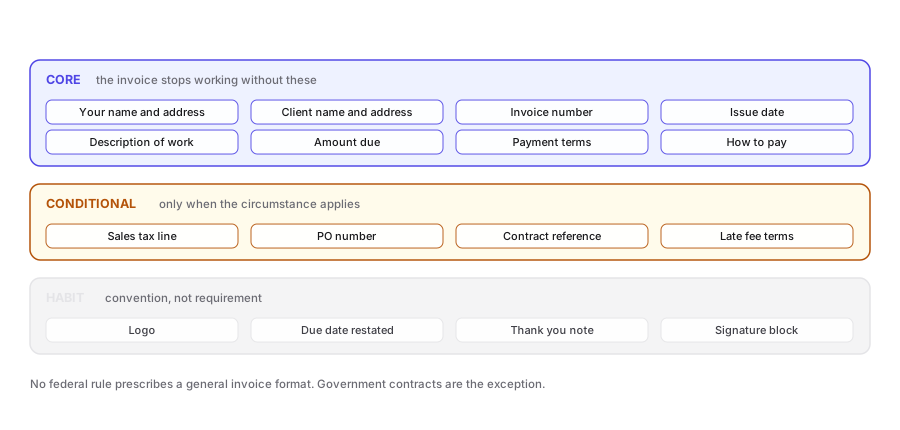
Several fields people treat as mandatory are pure habit
The fields you can drop are often the ones that feel most official. Start with a signature line. An invoice is a demand for payment under an agreement that already exists, and the agreement is where consent was recorded. A signature box implies the client is agreeing to something at the moment they receive the bill, which is not a position you want if the amount is ever disputed.
Next, your tax identification number. A commercial client who needs your Taxpayer Identification Number collects it on Form W-9, once, and keeps it on file. Printing an SSN on every invoice you email spreads a sensitive number across inboxes and shared drives for no gain. The exception is federal contracting: FAR 52.232-25(a)(3)(viii) tells the contractor to put its TIN on the invoice when the contract requires it elsewhere, so read the clause list before you leave it off. If you are a sole proprietor without an EIN, the IRS issues one at no cost, and it goes on the W-9 in place of your SSN.
Then there is late fee language appearing on the invoice for the first time. A late fee you never agreed in the contract is a term you are inventing after delivery. State law on interest between businesses varies, and a clause living only in an invoice footer is a weak position. Put the late fee in the signed agreement, then restate it on the invoice.
A consecutive number series is a control you keep for your own sake
Your numbering matters more than any other formatting decision, for a reason rarely stated out loud. A consecutive series is a completeness control. If your invoices run 2026-0041 through 2026-0068 with nothing missing, the series is self-evidencing: anyone can see that no invoice has been quietly removed. If 2026-0053 is absent, the first question is whether an invoice was issued and then deleted, and you have to answer it.
A gap in your invoice numbers is not an error. It is a question worth being able to answer, and the only good answer is a voided document that is still on file.
RunwayDue
The practical rules are short. Never delete an invoice that has left your building: void it, keep the void reason on the record, and the number stays accounted for. Never reuse a number after a correction: issue a credit note against the original and raise a new invoice. Never let two systems allocate numbers into the same series, because the collision will happen in your busiest week.
Formats that work: a year prefix plus a running counter (2026-0041), or a client code plus a counter (ACME-014). Formats that cause pain: anything restarting at 1 without a distinguishing prefix, and random identifiers, which cannot be checked for completeness at all.
When you save an invoice, RunwayDue allocates the next number and writes the document row inside a single database transaction, so a failure that rolls back the save also rolls back the counter. Bumping a counter and then failing to write the document leaves a permanent hole that cannot be repaired from the interface.
Printing sales tax and owing sales tax are two different problems
Sales tax appears on your invoice only if you have already decided you must collect it. That decision happens before the invoice, outside any invoicing tool, and it is the part people get wrong. RunwayDue's invoicing applies the rate you set per line and does not look one up for you, which is the same distinction from the other side.
Deciding involves at least three questions. Do you have nexus in the customer's state, whether physical or economic, the second of which the Supreme Court opened up in South Dakota v. Wayfair, Inc. (2018)? Is what you sell taxable in that state, given that most states tax goods, many do not tax professional services, and several tax specific services such as data processing or software as a service? And does this customer hold a valid exemption or resale certificate?
None of those is a formatting problem. All are legal and factual questions about your business.
The scale explains why. Avalara, a sales tax software vendor, states that its calculation product covers more than 12,000 US sales and use tax jurisdictions. Five states have no statewide sales tax (Alaska, Delaware, Montana, New Hampshire and Oregon), and Alaska still has local sales taxes in many boroughs and cities. Rates and rules change on their own schedules, mid fiscal year.
If you do charge it, show three things: the taxable subtotal, the rate as a percentage, and the tax amount on its own line. A blended total with tax buried inside it is unusable to your customer and to you.
A 1099 does not create your income, and your records should not depend on one
If you are a contractor, your obligation to report what you earned exists whether or not anyone sends you a form. A 1099 is a copy of what a payer told the IRS. It is not the source of truth about your revenue. Your invoices and your bank record are.
This matters more in 2026 than it did before. Section 70433 of the One Big Beautiful Bill Act (P.L. 119-21, enacted July 4, 2025) raised the information reporting threshold in Internal Revenue Code §6041 and §6041A from $600 to $2,000 for payments made after December 31, 2025, with inflation indexing after 2026. A client who paid you $1,400 across 2026 has no obligation to issue a Form 1099-NEC for it. That $1,400 is still your income.
So the records question is simple. Can you produce, for any year, a list of every invoice you issued, its date, its client, its amount, and the date and amount of every payment received against it? If yes, you do not need the forms to file accurately, and you can reconcile the forms you do receive against your own numbers rather than the other way around.
Reconciling matters, because payer forms go wrong in predictable ways. They are prepared on the payer's cash basis, so an invoice you issued in December and were paid for in January sits in a different year on their form than in your receivables. They sometimes include reimbursed expenses, or report a gross amount when a platform withheld a fee before the money reached you. When your records disagree with a form, you need to show why, not quietly adopt their number.
A purchase order reference is a payment gate, not a formality
If your client uses purchase orders, the PO number is functionally the most important field on your invoice, because without it the invoice may never reach the queue that pays it.
Here is the mechanism. A company that runs POs commits budget when the PO is raised, then matches incoming invoices against it. Two-way matching compares the invoice to the PO. Three-way matching compares the invoice, the PO and a goods or services receipt. An invoice arriving without a valid PO number does not enter the matching queue at all. It sits with a buyer, or in an exceptions pile. Nobody is refusing to pay: the invoice has simply not entered the system that pays people, and while it sits there no amount of chasing the buyer moves it.
Three habits fix almost all of this. Ask for the PO number before you start work, not when you invoice, because chasing it after delivery adds weeks. Check that the PO's remaining balance covers your invoice, since an invoice exceeding the PO value is another common reason for a hold. And put the number where a human and a scanner will both find it: near the top of the document, on its own labeled line.
RunwayDue stores a purchase order reference on the invoice record itself, so it prints on the document and stays attached for the life of the file rather than living in a covering email nobody can find later.
The remittance block is what actually gets you paid
One reason a well-formed invoice is not paid on time is that the recipient could not tell how to pay it without asking someone. Fix that with a labeled block near the total. The terms line above it is worth as much thought again: invoice payment terms that actually get you paid.
A remittance block needs four things.
- The method you accept, named explicitly. ACH, wire, check by mail, card. If you accept several, say which you prefer.
- The identifying details for that method, complete. For ACH: the account holder's legal name, the routing number and the account number. For a wire from abroad, the SWIFT or BIC as well. For a check, the exact payee name and the postal address.
- The reference the payer should quote, which is your invoice number. Without it, the money arrives as an unlabeled deposit and you spend an afternoon matching it.
- A deadline that is a real date, not only a term. "Due October 8, 2026 (Net 30)" beats "Net 30" alone, every time.
If you take card payments, disclose any surcharge on the document. Surcharging is governed both by state law and by card network rules, and the state position has been moving for years as bans are challenged in court. Check the rule where you are before you add one.
Five questions that decide whether a field belongs on your invoice
Use these in order. The first "no" removes the field.
- Does the client's accounts payable process require it in order to pay? A PO number, a cost center, a vendor ID. If yes, it is mandatory for you regardless of what any general guide says.
- Does your own bookkeeping need it to post the entry correctly? Date, amount, currency, tax split, client identity. If yes, it stays.
- Would a reviewer three years from now need it to understand what was sold? This is the description test, and it is why "consulting services" is a much worse line item than "Q3 lifecycle email audit, 14 hours".
- Is it required by a rule that actually applies to you? A sales tax rate you have determined you must charge, or the TIN a federal contract asks for. If you cannot name the rule, the answer is no.
- Does it change anyone's behavior? If removing it would change nothing about whether, when or how you get paid, it is decoration. Keep it if you like it, but do not call it required.
Keep the invoice for at least three years, in a form that does not drift
Keep the invoice, and the record of what was paid against it, for a minimum of three years. The IRS sets the period of limitations for records supporting an item of income or a deduction at 3 years in the ordinary case, and longer in the situations below. Count from the date you filed the return that invoice belongs to, not from the invoice date, and for a refund claim it is 3 years from filing or 2 years from paying the tax, whichever is later.
| Situation | Retention period | Source |
|---|---|---|
| Ordinary records supporting income or a deduction | 3 years | IRS, "How long should I keep records?" |
| Unreported income exceeding 25 percent of gross income shown | 6 years | IRS, same page |
| Claim for a worthless securities loss or a bad debt deduction | 7 years | IRS, same page |
| Employment tax records | 4 years after the tax is due or paid, whichever is later | IRS, same page |
| No return filed, or a fraudulent return | Indefinitely | IRS, same page |
Length is the easy part. The harder part is that the stored copy has to be stable. An invoice held as a live spreadsheet row silently changes when the client's address is updated or a tax rate is edited, and one day you will be unable to reproduce the document you actually sent. The fix is snapshotting: the document stores both parties' details and the computed totals as they stood when it was saved, rather than looking them up again later. RunwayDue does this, keeps the seller's details verbatim once an invoice has been sent, and stores each line's computed subtotal, discount, tax and total on the line itself rather than recalculating history on demand. A sent invoice can still be edited, and re-saving it recomputes the totals and refreshes the client's details, so handle a correction the way you would on paper: credit note, new number, new document.
Frequently asked questions
Is there a legal requirement for what a US invoice must contain?
Not for ordinary commercial invoices between private parties. No federal statute prescribes invoice contents the way the EU VAT Directive does. Two exceptions matter: 19 C.F.R. §141.86 prescribes what an invoice covering imported merchandise must show, and FAR 52.232-25(a)(3) sets out what makes a proper invoice on a federal contract, with the billing office free to return an improper one within 7 days. State sales tax rules can require specific tax disclosures if you collect sales tax, but they do not define the rest of the document.
Do I have to put my SSN or EIN on my invoices?
Usually not. A commercial client who needs your Taxpayer Identification Number collects it on Form W-9 and keeps it on file, and printing an SSN on every invoice spreads a sensitive number through email for no benefit. Federal contracts can differ: FAR 52.232-25(a)(3)(viii) calls for the TIN on the invoice when the contract requires it elsewhere. Sole proprietors who would rather not use an SSN can get an EIN from the IRS free of charge and put that on the W-9.
Does my invoice number have to be sequential?
Not under general US law, but treat it as though it were. A consecutive series is a completeness control: if a number is missing, anyone reviewing your books has to ask whether an invoice was issued and then removed. Void documents rather than deleting them, so every number stays accounted for.
Can I change an invoice after I have sent it?
You can, but not silently. If the amount or the tax changes, issue a credit note against the original and raise a new invoice with a new number. Edit a sent invoice in place and your client holds one version while you hold another under the same number, the exact situation a numbered series and an audit trail exist to prevent.
When does sales tax go on an invoice?
Only once you have determined that you must collect it: you have nexus in the customer's state, what you sold is taxable there, and the customer holds no valid exemption. That determination happens before the invoice. If you do charge it, show the taxable subtotal, the rate as a percentage, and the tax as its own line.
Will RunwayDue work out how much sales tax I owe?
No. It applies the rate you enter and totals it correctly. It does not determine nexus, look up rates by address, decide taxability, handle exemption or resale certificates, or file returns anywhere. Working out what you owe is a question for you and your accountant.
As a contractor, do I still report income if no 1099 arrives?
Yes. Income you were paid is reportable whether or not a payer files a form. This is more relevant from 2026 onward, because section 70433 of the One Big Beautiful Bill Act raised the 1099-NEC and 1099-MISC threshold from $600 to $2,000 for payments made after December 31, 2025, so fewer forms will be issued. Your invoices and bank records remain the record you file from.
What do I do when a 1099 does not match my own records?
Keep your own records and be able to explain the difference. The usual causes are timing, reimbursed expenses included in the total, and platform fees reported gross. Reconcile the form to your ledger rather than adjusting your ledger to the form, and ask your accountant how to present the difference.
How long do I need to keep my invoices?
At least three years in the ordinary case, and 6 years if you failed to report income exceeding 25 percent of the gross income shown on your return. See the retention table above for the longer periods. Keep the payment record alongside the invoice, not filed separately.
Why does my invoice need a purchase order number?
Because your client's accounts payable system may refuse to process it without one. Companies that use POs match invoices against the PO, often against a receipt as well, and an invoice with no valid PO number never enters that queue. Ask for the number before the work starts, and confirm the PO has enough remaining balance to cover what you are about to bill.
What counts as a proper invoice on a federal contract?
FAR 52.232-25(a)(3) lists ten items: (i) your name and address, (ii) invoice date and number, (iii) contract or order number, (iv) description, quantity, unit of measure, unit price and extended price, (v) shipping and payment terms, (vi) name and address of the official payment is sent to, (vii) who to notify about a defective invoice, (viii) your Taxpayer Identification Number, (ix) electronic funds transfer banking information, and (x) anything else the contract requires. Miss one and the billing office will return the invoice within 7 days as improper, which restarts your payment clock rather than shortening it. The same 7-day deadline binds the agency at 5 C.F.R. 1315.4(c)(2).