Every piece of financial advice written for software companies assumes you know what next month looks like. Recurring revenue, a churn rate, a growth curve. If you run projects, none of that applies. You might invoice forty thousand dollars in March and nothing at all in April, and both are normal.
The instinct is to average it out. Take last year, divide by twelve, call that your monthly number. That number is useless, because the whole problem is the variance, and averaging is how you delete the variance from view.
The mistake underneath the mistake
Ask most project businesses what their pipeline is worth and you get one figure. It usually includes a signed retainer, an invoice sent last week, and a proposal that has been sitting unopened for a month, all summed into a single confident total.
That total is not wrong so much as meaningless. It mixes money that is already in your bank with money that depends on somebody replying to an email.
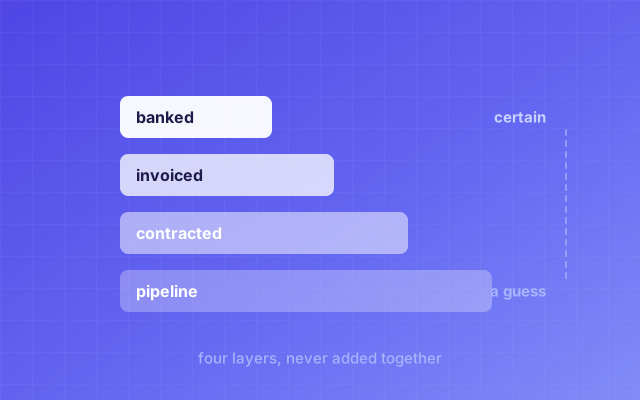
Four layers, sorted by certainty
Split everything you are owed or hope to be owed into four buckets. Order matters: each one is less certain than the one above it.
| Layer | What it is | How certain |
|---|---|---|
| Collected | Money in the bank | Certain |
| Invoiced | Billed, not yet paid | Very likely |
| Contracted | Signed, not yet billed | Committed |
| Pipeline | Proposed, not yet won | A hope |
Collected is the only number that is genuinely yours. Most tools show you this and stop.
Invoiced is work you have billed for and not been paid for. Split it by how overdue it is, because a week late and ninety days late are different problems with different fixes.
Contracted is the one almost nobody tracks, and it is the most useful of the four. It is money you have already won but not yet asked for: the retainer month that has not come round yet, the milestone still to be delivered. If you have signed a twelve month retainer in February, ten of those months are contracted revenue sitting in your future, and you can see them.
Pipeline is what is out there, weighted by your honest guess at winning it, which is how proposals are counted here, while the unbilled instalments of signed contracts count in full as contracted. A $40,000 proposal at thirty percent is $12,000 of pipeline, not $40,000.
Why you must not add them up
The moment you sum these four into one number, you have built a figure that is mostly hope and looks like a plan. That is how a business hires against revenue that never arrives.
The four layers are shown side by side, never summed. That constraint is the whole point.
The design note in our own dashboard
Keep them separate and each one answers a different question:
- Can I pay salaries this month? Look at collected plus invoiced falling due.
- Should I take on another project? Look at contracted, because that is work already promised.
- Do I need to sell harder right now? Look at pipeline, and at how thin the next two months are.
The number worth watching
Once you have the four layers, one derived figure is worth more than all of them: how many months of your average billing are already covered by what is outstanding plus what is contracted.
Call it secured months. If your trailing six month average is $16,000 and you have $24,000 outstanding plus $48,000 contracted, you have roughly four and a half months secured. That is a far better prompt than any revenue target, because it tells you when to start selling, not just whether last month was good.
Dry months are data, not failure
If you look back at a year of project work you will usually find two or three months where nothing landed at all. That is not a sign the business is broken. It is the shape of the business.
What matters is whether you saw them coming. A dry month you predicted in advance is a scheduling problem. A dry month that surprises you is a cash problem, and they are not the same thing; a cash runway calculator shows which month would come up short against your own costs.
Frequently asked questions
What does lumpy revenue mean?
Income that arrives in bursts tied to project events rather than in equal amounts on the same day each month. You might invoice forty thousand dollars in March and nothing at all in April, and both are normal. Almost every piece of financial advice written for software businesses assumes a monthly cycle, which is why so little of it is usable if you run projects.
Why should I not just average my year and divide by twelve?
Because the variance is the whole problem, and averaging is how you delete the variance from view. A monthly average tells you what a typical month would have looked like if your business worked in a way it does not. It cannot tell you which months were empty or when the next empty one is coming.
What are the four layers?
Collected is money in the bank and is the only figure that is genuinely yours. Invoiced is work you have billed for and not been paid for. Contracted is signed but not yet billed, such as the retainer months that have not come round yet. Pipeline is proposed but not yet won, weighted by your honest guess at winning it. Each layer is less certain than the one above it.
Why must I not add the four layers together?
Because the moment you sum them you have a figure that is mostly hope and looks like a plan, and that is how a business hires against revenue that never arrives. Kept separate, each layer answers a different question: collected plus invoiced tells you whether you can pay salaries, contracted tells you whether to take on more work, and pipeline tells you whether to sell harder right now.
What is contracted revenue and why does it matter?
It is money you have already won but not yet asked for. Sign a twelve month retainer in February and ten of those months are contracted revenue sitting in your future. It is the layer almost nobody tracks and the most useful of the four, because it is the only one that tells you what is committed before you have raised a single invoice against it.
How should I weight my pipeline?
By your honest guess at the odds, applied to each proposal rather than to the total. A forty thousand dollar proposal at thirty percent is twelve thousand dollars of pipeline, not forty thousand. The discipline is applying the weighting before the number reaches any figure you look at, not afterwards.
What are secured months?
How many months of your average billing are already covered by what is outstanding plus what is contracted. If your trailing six month average is sixteen thousand dollars and you have twenty four thousand outstanding plus forty eight thousand contracted, you have roughly four and a half months secured. It is a better prompt than any revenue target, because it tells you when to start selling rather than only whether last month was good.
Is a month with no revenue a sign something is wrong?
Usually not. Look back at a year of project work and you will typically find two or three months where nothing landed, and that is the shape of the business rather than a fault in it. What matters is whether you saw it coming. A dry month you predicted is a scheduling problem; a dry month that surprises you is a cash problem, and they are not the same thing.