This trips up almost everyone who starts invoicing in India, and the explanations you find are usually written by tax professionals for tax professionals. Here is the version for someone who just needs to raise a correct invoice this afternoon.
The rule in one sentence
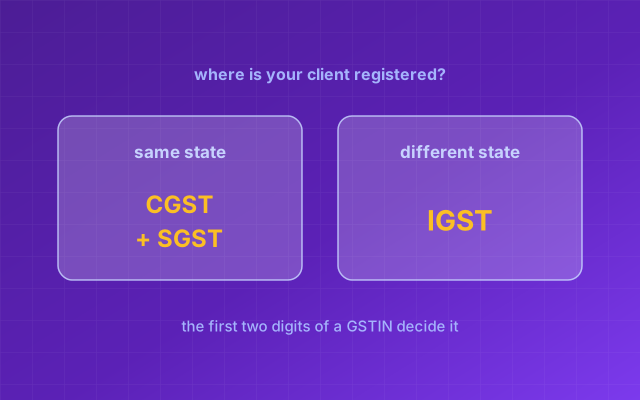
If your client is in the same state as you, you charge CGST and SGST, half the rate each. If they are in a different state, you charge IGST at the full rate.
That is the whole thing. Eighteen percent GST on a Maharashtra to Maharashtra invoice becomes nine percent CGST plus nine percent SGST. The same invoice from Maharashtra to Karnataka becomes eighteen percent IGST.
The field that actually decides it
It is not the client's billing address, and it is not where the work is done. It is the place of supply, the thing invoicing resolves for you, and for most services that means the state where your client is registered.
For a design studio in Mumbai invoicing a company registered in Bengaluru, the place of supply is Karnataka, and the answer is IGST. It does not matter that the meetings happened over video, or that the person you deal with lives in Pune.
Where the state code comes from
The first two digits of a GSTIN are the state code. That is the fastest way to check.
| Starts with | State |
|---|---|
| 07 | Delhi |
| 09 | Uttar Pradesh |
| 19 | West Bengal |
| 27 | Maharashtra |
| 29 | Karnataka |
| 33 | Tamil Nadu |
| 36 | Telangana |
So a client whose GSTIN begins 29 is in Karnataka. If yours begins 27, that is an interstate supply and IGST applies.
Clients outside India
An invoice to a client abroad is an export of service, and no GST is charged on it at all. RunwayDue does not file GST returns at all; if filing is the job, the comparison with Refrens says so plainly.
You do need to be set up for that properly. Most service exporters supply under a Letter of Undertaking, which lets you export without paying integrated tax and then claiming it back. Filing the LUT is an annual formality on the GST portal and takes a few minutes, but you have to actually do it. Without one, the position is different and more expensive.
What a tax invoice has to carry
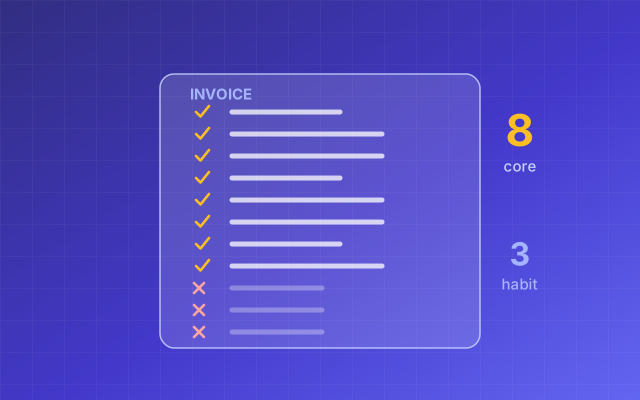
Beyond the tax split, a compliant tax invoice needs a few things people routinely leave off:
- Your GSTIN and your client's GSTIN
- A sequential invoice number, with no gaps you cannot explain
- The place of supply, stated explicitly
- HSN or SAC codes on the line items
- The tax broken out per rate slab, not just one total
- The total amount in words
That last one surprises people, but it is expected on a tax invoice and it costs nothing to include.
The mistakes that cost the most
Charging CGST and SGST on an interstate supply. Your client cannot claim the credit properly, and fixing it means a credit note and a fresh invoice. This is the single most common error and it usually comes from copying last month's invoice for a different client.
Numbering with gaps. If invoice 41 exists and 42 does not, you need to be able to say why. Cancel by issuing a credit note or voiding, and keep the number. Never delete an issued invoice.
Getting the client's state from their address instead of their GSTIN. Head office in one state, registration in another, is common. The GSTIN wins.
Frequently asked questions
When do I charge CGST and SGST instead of IGST?
If your client is in the same state as you, you charge CGST and SGST at half the rate each. If they are in a different state, you charge IGST at the full rate. Eighteen percent on a Maharashtra to Maharashtra invoice becomes nine percent CGST plus nine percent SGST; the same invoice from Maharashtra to Karnataka becomes eighteen percent IGST.
What is place of supply?
The field that actually decides the split. It is not the client's billing address and it is not where the work was done. For most services it is the state where your client is registered. A design studio in Mumbai invoicing a company registered in Bengaluru has a place of supply of Karnataka and charges IGST, whatever address the emails went to.
How do I find out which state my client is in?
From the first two digits of their GSTIN, which are the state code. That is faster and more reliable than reading their address, because a head office in one state and a registration in another is common, and the registration is what decides the tax.
Do I charge GST on an invoice to a client abroad?
No. An invoice to a client abroad is an export of service and no GST is charged on it. You do need to be set up for that properly, though, rather than simply leaving the tax off.
What is a Letter of Undertaking and do I need one?
Most service exporters supply under a Letter of Undertaking, which lets you export without paying integrated tax and then claiming it back. Filing it is an annual formality on the GST portal that takes a few minutes, but you have to actually do it. Without one the position is different and more expensive.
What does a tax invoice have to carry?
Your GSTIN and your client's, a sequential invoice number with no gaps you cannot explain, the place of supply stated explicitly, HSN or SAC codes on the line items, the tax broken out per rate slab rather than as one total, and the total amount in words.
What is the most common GST mistake on an invoice?
Charging CGST and SGST on an interstate supply. Your client cannot claim the credit properly, and fixing it means a credit note and a fresh invoice. It usually comes from copying last month's invoice for a different client. The other frequent one is taking the client's state from their address rather than their GSTIN, where the GSTIN always wins.