TL;DR
- Every payment term is a loan: net 30 means you deliver the work, absorb your own costs, and finance your client for a month at zero interest.
- "Due on receipt" is not a date, so an accounts payable system that needs one will assign a date of its own choosing, and it will not be the one you wanted.
- If the first time a client sees your payment terms is on the invoice, the terms are a request rather than an agreement, and requests get renegotiated at the worst possible moment.
- A late fee is chargeable because the signed contract created it before the work started; a percentage typed onto an invoice after the fact is a note, not an obligation.
- Federal agencies operate under the Prompt Payment Act (31 U.S.C. ch. 39, implemented at 5 CFR part 1315), which generally makes payment due 30 days from the later of receipt of a proper invoice or government acceptance of the work, and requires interest to be paid automatically when the agency is late.
- A large client paying late may not have refused at all; check whether the invoice failed a validation rule in an accounts payable portal before you assume anything about intent.
Payment terms are the sentence on your invoice that decides when money arrives. Most people copy it from the last invoice, which they copied from a template, which somebody wrote a long time ago and nobody has read since. This is about choosing it on purpose.
Payment terms are a financing decision you make on your client's behalf
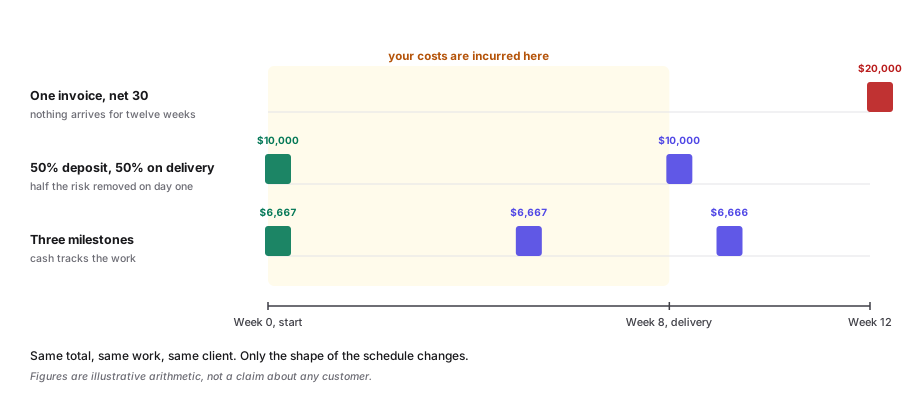
Every payment term is a loan. Net 30 says you will deliver the work, absorb your own costs, and wait thirty days from the invoice date before the money moves. For those thirty days your client holds cash that is contractually yours and pays nothing for it. That may be a loan worth making, but you should know you are making it.
It matters more when your revenue is lumpy. A studio that bills four large projects a year has no rolling stream of receipts to cover a thirty day gap, so one slipped invoice is not an inconvenience, it is the month. Choose terms by looking at the gap between when you spend money on a job and when you get paid for it, then set them so the gap stays inside what your bank balance can absorb.
Every payment term is a loan. The only question is whether you meant to make it.
RunwayDue
Net 30 and due on receipt signal different things, and only one of them is a date
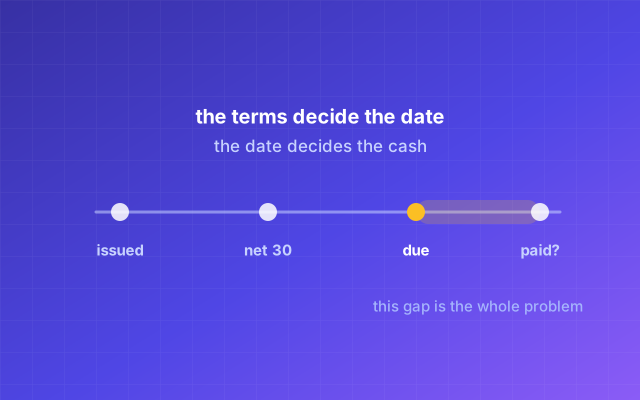
Net 30 means payment is due thirty days after the invoice date. Due on receipt means payment is due immediately, which sounds stronger and is usually weaker, because "immediately" is not a date and a date is what every accounts payable system needs.
Here is what actually happens. A clerk opens an invoice marked "due on receipt". Their system has a required field called due date and they cannot leave it blank, so they enter something: today plus the vendor default, today plus thirty, or the next scheduled payment run. You have handed the choice of your own due date to a stranger. A printed due date of October 9 leaves nothing to interpret, and it is the version an aging report can flag.
Due on receipt still has a place. It works when the buyer is a person rather than a department, when the amount is small, and when payment is by card or link rather than a payment run. It stops working the moment there is a procurement function on the other side. The signal matters too: net 15 reads as a business that has thought about its cash, while due on receipt on a five-figure invoice to a large company reads as naive.
What each common term actually does to your cash
The table below is the practical version, not the dictionary version. It assumes a client who intends to pay, not one who is stalling. The fields the terms sit beside are covered in what a US invoice has to include.
| Term | What it says | What it means for your cash | Best used when |
|---|---|---|---|
| Due on receipt | Pay now | No date for AP to work with, so a clerk or a system picks one for you | Small amounts, card or link, a human buyer, deposit invoices |
| Net 7 | Due 7 days after the invoice date | Can land inside a single approval cycle or fall outside it entirely, so it either works brilliantly or is ignored | Repeat clients who pay by transfer |
| Net 15 | Due 15 days after the invoice date | Short enough to clear a single approval cycle, still fast enough to matter | The sensible default for freelancers and small studios |
| Net 30 | Due 30 days after the invoice date | One full month of financing, provided by you, at zero interest | Mid-sized and larger clients, anything routed through procurement |
| Net 45 and net 60 | Due 45 or 60 days out | Two months of exposure per invoice; you are now running a receivables book | Large clients where it is non-negotiable, priced accordingly |
| 2/10 net 30 | 2 percent off if paid within 10 days, otherwise full amount at 30 | You buy speed with margin: on a $10,000 invoice, $200 for twenty days | Clients with a policy of taking early-payment discounts |
| 50 percent deposit, 50 percent on delivery | Half up front, half at the end | Exposure halves and the start of work is self-funding | Defined projects, new clients, anything with material costs |
| Milestone billing | Payment attached to named deliverables | Cash arrives during the work rather than after it | Anything running longer than about six weeks |
| Net 30 from month end | Due 30 days after the end of the month of issue | Quietly becomes up to 60 days; an invoice dated the 2nd waits nearly two months | Almost never, unless you priced for it |
The last row is the one people accept without reading. "Net 30 following month end", "net 30 EOM" and "30 days end of month" are the same clause: an invoice issued on the 2nd is not due 30 days later, it is due 30 days after the 31st. Over a year of monthly invoicing that permanently adds about another half month of revenue to the money you are owed but do not have.
The terms line is a negotiation you already lost if the invoice is where it first appears
Payment terms belong in the proposal and the contract, not on the invoice. By the time you send an invoice the work is done, your leverage is spent, and any term the client did not agree to in advance is only a suggestion.
The pattern is familiar. You quote a price, the client says yes, you do six weeks of work, you invoice at net 15, and the reply says "our standard terms are net 60". You are now negotiating from the weakest position available: you have already delivered, you want the relationship to continue, and the alternative to accepting is a fight over money you have earned. That is a bad place to be arguing from, whatever you decide to do next.
Move the sentence forward and everything changes. In a proposal, terms are one line among many that the client is weighing while they still want something from you. Objections surface then, when the answer can be "net 60 is fine, and here is the price for net 60", or "we can do net 30 with a 40 percent deposit". Those trades exist before the work and vanish after it. It is also the argument for running proposals, contracts and invoices as one chain, so terms cannot drift between the stage where they were agreed and the stage where they are enforced.
A 50 percent deposit changes what the conversation is about
A deposit does something no payment term can do: it moves the question from "when will you pay" to "have you paid". Before the deposit lands there is no schedule, no calendar slot and no work. That is a far simpler conversation than chasing a balance after delivery, because nothing has been given away.
The financial effect is straightforward. Half up front halves what you can lose on any single engagement, and if it covers your direct costs the project funds itself rather than being funded by your savings. There is a behavioral effect too: a client who has paid a deposit has been through their own approval process once already, before there is any dispute to color it, so you know the route the final invoice will take and you know it works.
Deposits are also the cleanest filter for a new client. Someone who agrees to everything and then goes quiet when the deposit invoice arrives has told you what the final invoice would have looked like, at a point where it cost nothing to find out.
Milestone billing beats one invoice on anything longer than six weeks
For a long project the right question is not what terms to put on the final invoice, it is how to avoid having one large final invoice. Milestone billing attaches payments to named deliverables, so cash arrives while you are still spending money on the work. For work that repeats on a rhythm instead of reaching milestones, that is recurring billing.
Milestones work when three things are true. Each names a deliverable a non-specialist can verify: "wireframes approved", not "design phase progressing". Each has an amount fixed in the contract, so nothing is negotiated later. And each triggers an invoice on a date, not on a feeling that it is time to bill.
Compare the exposure. A $40,000 project billed once at net 30 on completion means that at the moment you finish, $40,000 of your money is outside your control for a month. Billed 25 percent on signature, 25 percent at design sign-off, 25 percent at build complete and 25 percent at launch, maximum exposure is $10,000, and you get three earlier signals about whether this client pays. If milestone two is late you learn it in week five rather than week sixteen, and week five is when you can still slow down. In RunwayDue the contract holds each milestone's amount and date, and when one falls due the contract page flags it as uninvoiced and opens an invoice prefilled with that amount and label. You press the button; it does not bill itself.
A late fee is only enforceable if the contract created it
A late fee is chargeable when the agreement the client signed says so, before the work started. A percentage typed onto an invoice after the fact is a note, not an obligation, and any accounts payable department knows it. Which is an argument for the terms living in the signed contract rather than appearing first on an invoice.
For a late fee clause to do its job it needs four things.
- It exists in the signed agreement. Not the invoice, not the email, not the terms page nobody clicked. In the document the client signed.
- It states a rate and a period without ambiguity. "1.5 percent per month on any amount unpaid more than 15 days after the due date" is a clause. "Late fees may apply" is not.
- The rate is close to what the delay actually costs you. Keep it near what it would cost you to borrow through the gap. A charge that looks like a punishment rather than compensation for the delay invites a challenge, and the rate is the part a client's counsel will look at first.
- It respects the interest rules of the governing state. Contract interest is regulated at state level and the rules differ, including on caps and on whether business-to-business agreements are treated differently from consumer ones. Check the state whose law governs your contracts, and make sure that is a clause you wrote rather than one you discover later.
Two things sit beyond your own contract. If your client is a federal agency, the Prompt Payment Act (31 U.S.C. ch. 39, implemented at 5 CFR part 1315) already sets the clock. Payment is generally due 30 days from the later of receipt of a proper invoice by the designated billing office or government acceptance of the work, with acceptance deemed to have happened 7 days after delivery unless the agency says otherwise (5 CFR 1315.4(b)(1)(ii)), and the agency must pay interest automatically when it is late, without you asking (5 CFR 1315.10(a)). Separately, a number of states have prompt payment statutes covering construction and state government contracts, with their own deadlines and interest rates. If most of your revenue is construction or public sector, your state's statute may give you more than your contract does.
None of this is legal advice, and the late fee clause is one of the few parts of a services contract worth paying a lawyer to review once. You will reuse it for years.
Check the accounts payable system before you decide the client is stalling
When a large company pays late, check the accounts payable system before you assume a decision was made. The invoice may have been rejected or parked, and the person who hired you would never hear.
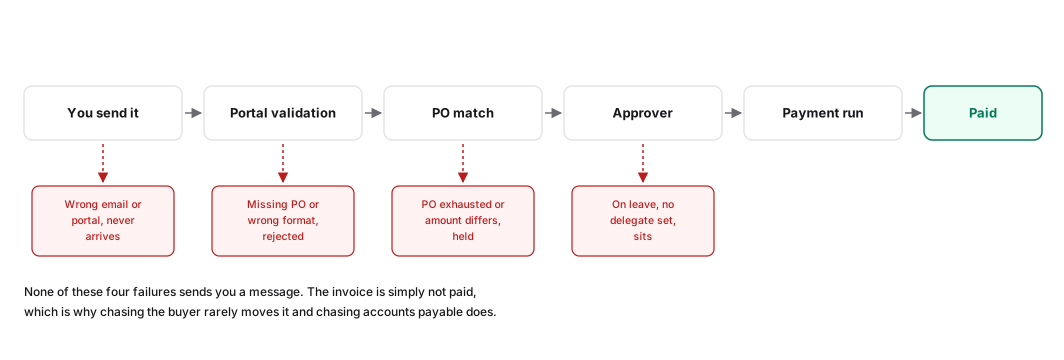
The failures worth ruling out first are boring and preventable. There is no purchase order number on the invoice, and the portal will not accept one without it. The PO exists but is exhausted, so your invoice exceeds the remaining balance. The invoice is addressed to your contact rather than to the legal entity on the PO. The line items do not match the PO lines, so a three-way match fails. It was emailed to a person instead of submitted through the portal, and that person is on leave. The bank details differ from the vendor record, which triggers a fraud hold, correctly.
Notice what those have in common: none of them produces a message to you. A rejected invoice stops inside a system that has no reason to email a vendor, and the person who commissioned the work may never see the queue it stopped in.
Treat the first invoice to any new client as a setup task. Before you send it, ask four things in one message: do I need a PO number, what is it, where does the invoice go, and who approves it. Then put that PO number on every invoice for that client. When an invoice passes its due date, your first move is not a chasing email to your contact, it is a message to accounts payable asking for the status of the invoice by number. "Rejected on the 14th, missing PO" is an answer you can act on in ten minutes.
Five questions that separate terms that get paid from terms that get argued about
Run these before you send a proposal, not after you send an invoice.
- Where does the client first see these terms? If the answer is the invoice, fix that before anything else.
- Is the due date a date? Not a phrase, not a condition, a calendar date printed on the document. If a system has to infer your due date, it will infer one that suits the system.
- What is my maximum exposure on this job at any single moment? Take the largest amount that can be outstanding at once. If that number would hurt, you need a deposit, milestones, or both.
- Who approves this, and does the invoice contain what they need? PO number, correct legal entity, matching line items, right submission channel. Ask once, at the start, in writing.
- What happens on day one of being late, and did I decide it in advance? If the answer is "I will think about it then", you will not.
Terms that survive all five are hard to argue with, because there is nothing left to interpret: the client agreed to them while they still wanted something, the date is printed, the exposure is capped, and the response to lateness was decided in advance. Question one does the most work. A term the client meets for the first time on the invoice is a term they get to have an opinion about.
Following up is a schedule; chasing is what happens when you did not have one
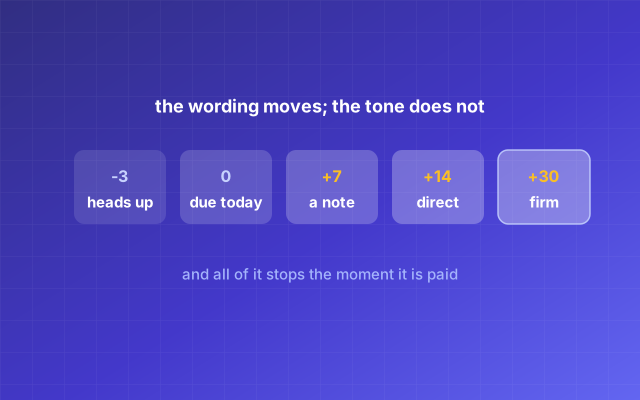
Following up is a small, dated, unemotional message that goes out because it was always going to. Chasing is what you do at day fifty when you finally look at your bank balance, and it is worse in every way: later, angrier, and more damaging to the relationship than the thing it reacts to. There is a longer piece on the wording itself: how to chase an overdue invoice without damaging the relationship.
The difference is entirely in the setup. A sequence decided in advance might run: a note three days before the due date, a factual message the day after it goes overdue, another at day seven, another at day fourteen, and at day thirty a message that stops being about this invoice and starts being about whether work continues. Each states the invoice number and amount and carries the payment link. None of them is annoyed, because none was written at the moment you felt annoyed.
Two rules make it work. Send during working hours on working days, because a reminder landing on Sunday reads as pestering and will not be picked up until Monday anyway. And escalate the recipient, not the tone: after the second unanswered message the useful move is to copy accounts payable, not to write a sharper sentence to the same person. The reason to automate this is not laziness. It is that the follow-ups you send by hand are the ones you send when you are irritated, and the ones you never send are the ones for clients you like. A schedule has no moods.
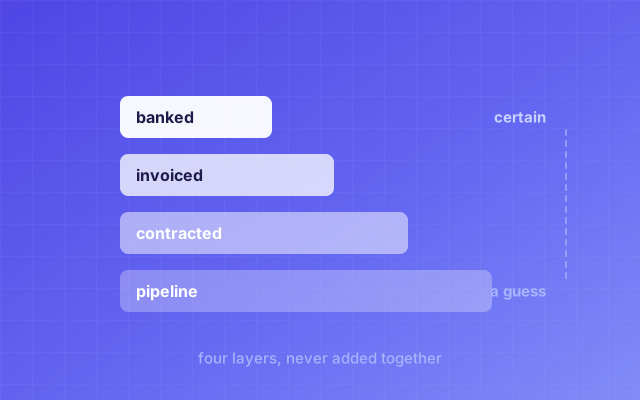
A term you cannot measure is a wish, so the last piece is visibility. If you cannot answer "what is overdue right now, by how much, and for how long" in under a minute, you will find out too late to act cheaply. The minimum is an aging view checked weekly, on the same day. Terms, deposits, milestones and follow-ups all exist to make the shape of your cash visible while it is still cheap to change.
Frequently asked questions
What is the difference between net 30 and due on receipt?
Net 30 means payment is due thirty days after the invoice date; due on receipt means payment is due immediately. The practical difference is that net 30 produces a specific calendar due date an accounts payable system can store and act on, while due on receipt does not, so somebody or something on the client's side picks a date for you.
Should a freelancer use net 15 or net 30?
Net 15 is the better default for most freelancers, because it is short enough to clear a single approval cycle rather than two, and it still gets money to you within two weeks. Move to net 30 when a client's procurement process genuinely requires it, and treat that as a concession you traded for something rather than a default you accepted.
Is it normal to ask for a 50 percent deposit?
Yes. Asking for half up front on project work is a common and unremarkable request, and it is easiest to ask for when it appears in the proposal as one line of the commercial terms rather than as a special request made after the client has already said yes.
Can I charge a late fee if it is not in the contract?
Generally no. A late fee is enforceable because the client agreed to it in the signed agreement before the work began, so a percentage added to an invoice afterwards is best understood as a request rather than an obligation. Add the clause to your contract template now, state a specific rate and period, and check the interest rules of the state whose law governs your contracts. This is not legal advice.
What does net 30 from end of month actually mean?
It means payment is due thirty days after the last day of the month in which the invoice was issued, which stretches the real wait to as much as sixty days. An invoice dated the 2nd is not due on the 1st of the next month, it is due thirty days after the 31st. Treat the clause as a net 60 term and price it that way.
Why might a large client pay late even when they are happy with the work?
Often the cause is a step in an accounts payable system rather than a refusal: a missing purchase order number, a mismatch against the PO lines, the wrong legal entity, submission by email instead of through the portal, or bank details that do not match the vendor record. None of those generates a message to you, so ask accounts payable for the status of the invoice by number before you assume anything about intent.
Do federal agencies have a legal deadline to pay me?
Yes. The Prompt Payment Act (31 U.S.C. ch. 39), implemented at 5 CFR part 1315, generally makes payment due 30 days from the later of the date the designated billing office receives a proper invoice or the date the government accepts the supplies or services, with acceptance deemed to occur 7 days after delivery unless the agency states otherwise (5 CFR 1315.4(b)(1)(ii)). Interest runs automatically when the agency is late, without the vendor asking (5 CFR 1315.10(a)). The rules also govern how quickly an agency must return an invoice it considers improper, so read part 1315 if you invoice the federal government regularly.
What should the payment terms line on the invoice actually say?
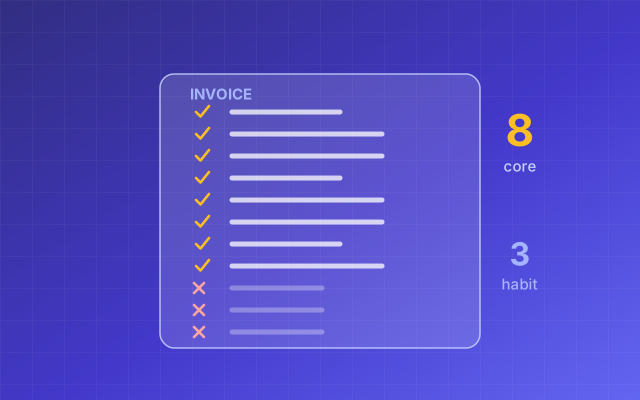
Three things: the term ("net 15"), the calendar due date it produces ("due October 9, 2026"), and how to pay. If a late fee or a suspension right exists in the signed agreement, restate it in one short line. The invoice is repeating terms agreed earlier, so it should read as a reminder rather than an announcement.
How often should I follow up on an overdue invoice?
Decide the schedule before the invoice is late, then keep to it: a note shortly before the due date, one the day after it goes overdue, then roughly weekly, escalating to accounts payable rather than escalating in tone. Send on working days during working hours, and keep every message short, factual and carrying the payment link.
Should I stop work when an invoice is unpaid?
Only if your contract says you can, which is why the clause is worth having. A suspension clause that lets you pause work after a stated number of days overdue is one of the few remedies a service business can use without going anywhere near a court, and it is far easier to invoke calmly when the client agreed to it at signature than to invent in the middle of a dispute.