TL;DR
- Treat a late invoice as stuck until you know otherwise: on day one, check that it reached whoever pays it, with the purchase order and terms their system needs.
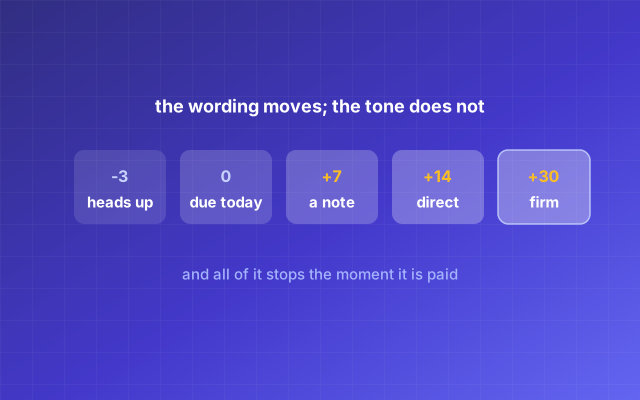
- Then climb one rung at a time: reminders, a call, a final notice, pausing work, a demand letter, and finally small claims, a collection agency or a write-off. Escalate the step, not the tone.
- Pausing work depends on what your agreement says; a late fee depends on the agreement and on the law of the state that governs it. Small claims limits depend on the court, which may have to be one where your client is, and on whether you file as yourself or as a company.
- The federal debt collection law generally does not reach a business chasing its own business-to-business invoice in its own name, and a cash-method freelancer generally has no bad debt to deduct.
When a client won't pay, check your own side first, then climb one rung at a time and give each rung a date. Our advice is to keep to the order: each later rung takes more of your time or money and puts more strain on the relationship. Below, one invoice goes up the whole ladder on a real calendar, with the rule behind each legal step. It picks up where the past-due reminder emails stop, at about 30 days late.
One unpaid invoice, walked up the ladder on a calendar
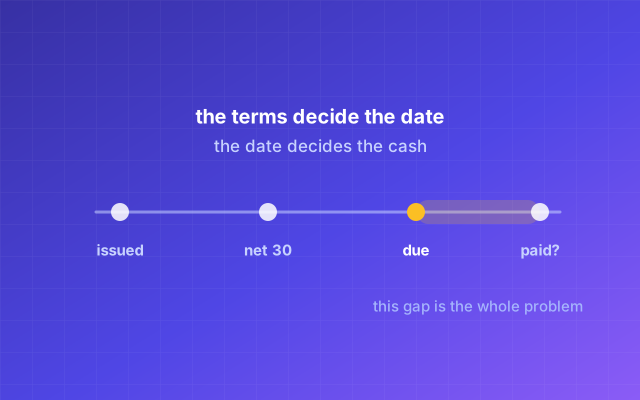
The example is invoice INV-0142 for $3,600, dated Tuesday, September 1, 2026, on net 30, so it falls due on Thursday, October 1, 2026 (the net terms calculator gives the same date). Nothing arrives.
| Date | Days late | Report column | Rung |
|---|---|---|---|
| Friday, October 2, 2026 | 1 | 1 to 30 | Check your side |
| Thursdays, October 8 and 15, 2026 | 7 and 14 | 1 to 30 | Reminders |
| Friday, October 16, 2026 | 15 | 1 to 30 | A phone call |
| Monday, November 2, 2026 | 32 | 31 to 60 | The 30-day reminder, moved off Saturday, October 31 |
| Thursday, November 5, 2026 | 35 | 31 to 60 | Final notice, pay by November 19 |
| Friday, November 20, 2026 | 50 | 31 to 60 | Demand letter, pay by December 4 |
| Monday, December 7, 2026 | 67 | 61 to 90 | Small claims, or a collection agency |
| Thursday, December 31, 2026 | 91 | 90+ | Ask your accountant whether, and when, it becomes a write-off |
The dates come from RunwayDue's own date code and the columns from its aged-receivables report. The pace between rungs is our suggestion, not a rule, and a client who replies with a date resets the clock. The code does not know public holidays: Veterans Day and Thanksgiving 2026 fall inside the notice and demand windows (OPM federal holidays, checked on 28 October 2026). Automatic reminders count days on the server's UTC clock, so in US time zones one usually arrives the afternoon or evening before its date, and a Monday reminder can arrive on Sunday evening.
1. Check your side first: assume the invoice is stuck, not refused
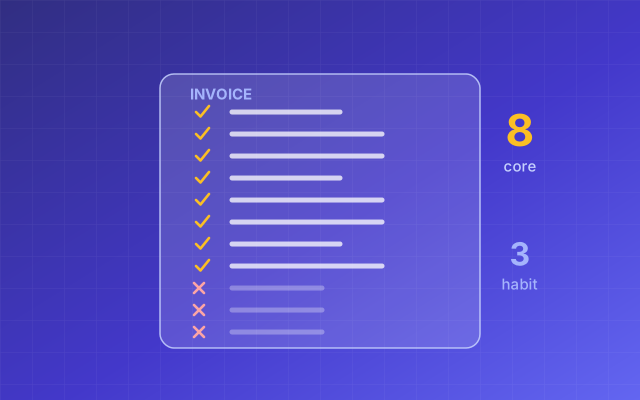
On day one, assume the invoice is stuck. An invoice can be held in a client's accounts payable process without anyone telling you: a missing or exhausted purchase order, the wrong legal entity, lines that do not match the PO, an email to a person instead of the portal, or bank details that differ from the vendor record. The full list, and how to set up a new client so none of it happens, is in the guide to invoice payment terms.
So the first message goes to accounts payable and asks for the status of invoice INV-0142 by number. Federal agencies are a separate case: if one pays late, the interest penalty is generally due without you asking for it, though not, for example, while payment is held up by a dispute over the amount or the contract (5 CFR 1315.10(b)(2) and (c), checked on 28 October 2026).
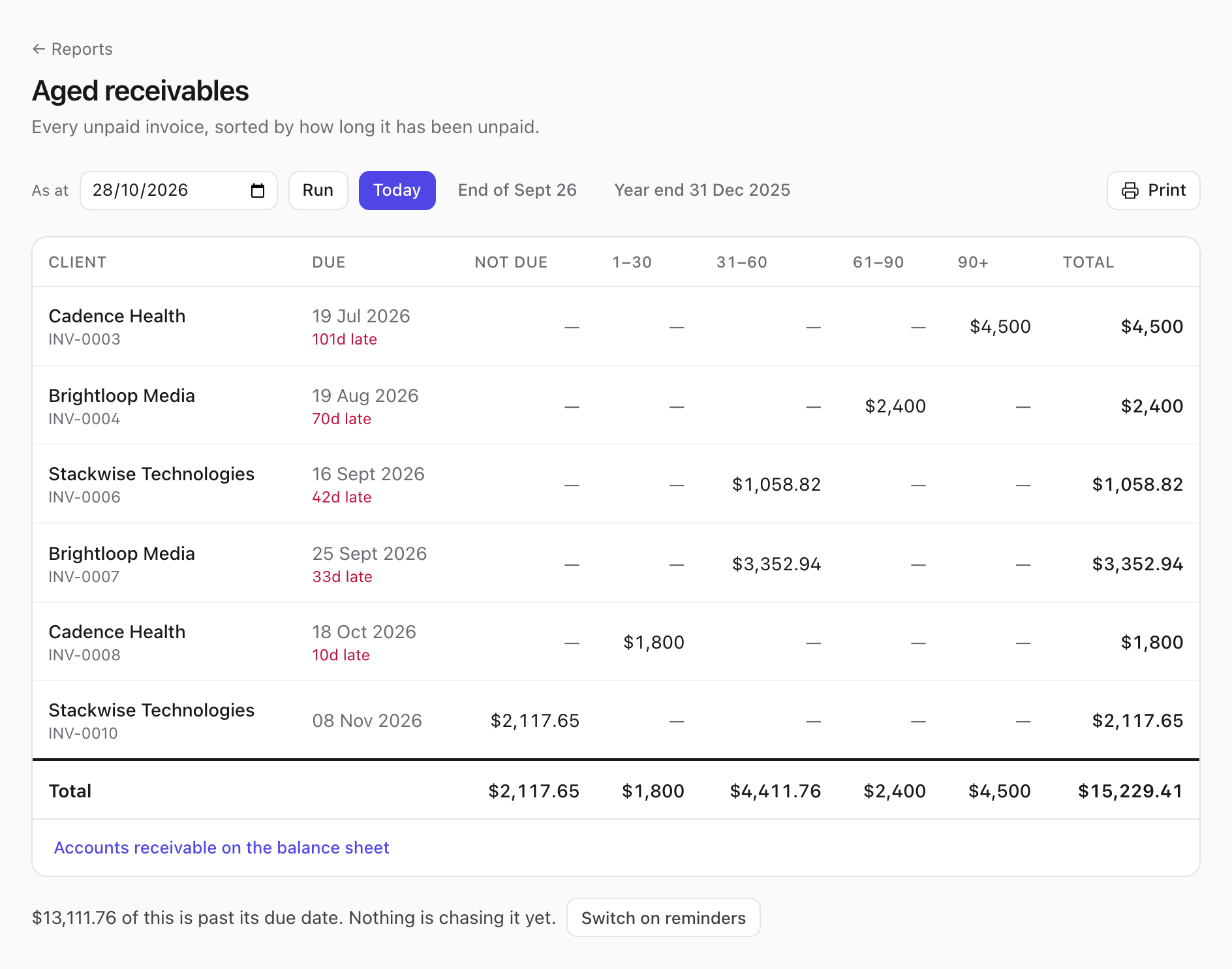
In RunwayDue every late invoice shows its days overdue on any plan, and the invoice list has an Overdue filter. On Pro, the aged-receivables report lists every unpaid invoice oldest first and says underneath whether anything is chasing the late money.
2. Reminders carry the first 30 days
Each reminder is a little more direct than the last and asks for one thing. The wording is in five reminder emails, so this guide covers what happens around them.
On Pro, and during the 14-day Pro trial every new account starts with, RunwayDue sends them once you switch automatic reminders on. The default Standard schedule goes 3 days before the due date, on it, then 7, 14 and 30 days late, skipping Saturdays and Sundays as the server counts them (in UTC), at most six per invoice, and stops once you record the payment, void the invoice or pause its reminders. Persistent runs to 45 days late across eight rungs, so raise "Never send more than" to 8 if you choose it; at the default of 6 it stops after the 21-day rung.
On Free, an overdue invoice has an Email a reminder button that sends the same wording by hand, and following up an invoice you already sent never uses one of Free's 5 invoices a month. A payment link saved in Settings adds a Pay now button to the client's copy of an unpaid invoice.
Escalate the step, not the tone
Each rung should change what you do and who you ask, not how annoyed you sound. Once the invoice is more than a week late, ask for a date rather than for payment, because accounts payable can give you a date without the authority to release funds. After the second unanswered message, copy accounts payable or whoever approves invoices. Once it is more than three weeks late, ask for a reply, even a bad one.
| Stage | What you ask for |
|---|---|
| Reminder, 1 to 7 days late | Who needs to sign it off |
| Reminder, 8 to 21 days late | A payment date |
| Reminder, 22 to 45 days late | A reply, even "not yet" |
| Phone call | Where it is stuck, and a date |
| Final notice or demand letter | Payment by a named date, before a named next step |
RunwayDue's built-in wording follows the first three rows and never threatens. Anything firmer is yours to write and send.
Asking for a reply matters because a silent invoice may be a dispute nobody has mentioned. "We are not paying this because the scope changed" gives you something to work with; silence gives you nothing. Handle a dispute differently from silence: ask for the undisputed part now, go back to what was agreed in writing, and if you settle on a plan or a reduced amount, write it down with dates and pause that invoice's automatic reminders while it runs.
3. Call when the 14-day reminder gets no answer
About two weeks late, pick up the phone. Name the invoice by number, amount and due date. Ask what is holding it: an approval, a PO, a query about the work, or cash. Ask for a payment date, and who to speak to if that date passes. Then confirm what was agreed by email the same day, because a promise on the phone is easy to forget.
If you get a date, pause the automatic reminders on that one invoice and resume them if the date passes.
4. A final notice names a date and a next step, and you send it yourself
A few days after the last reminder, send a final notice for an unpaid invoice: the amount, the invoice number and due date, what you have already sent, a pay-by date written as a date, and the one step you will take if it passes. In the example it goes on Thursday, November 5, 35 days late, with a pay-by date of Thursday, November 19. Fourteen days is the example's choice, not a standard. RunwayDue does not send this for you, because its reminders never threaten, so pause the invoice's automatic reminders when your notice goes.
If your signed agreement sets a late fee, quote it and work out what your clause comes to first. Whether a fee can be charged depends on what the client agreed to and on the law of the state that governs the agreement. In the UK, a business owed money by another business can claim statutory interest at 8% plus the Bank of England base rate unless the contract sets a different rate (GOV.UK, checked on 28 October 2026).
5. Pause work only if your agreement gives you the right
Stopping work can be your strongest lever and your riskiest one: without the right to stop, you may hand the client an argument that you broke the agreement first. Look for a clause that lets you suspend work after a stated number of days overdue. If there is one, follow it exactly: notice in writing, the date work stops, and what restarts it. If there is none, ask a lawyer before you stop, and never hold back anything the agreement says already belongs to the client.
RunwayDue's default agreement text has no suspension clause. It says invoices are payable within fifteen days, that delivered work stays payable if either side ends the agreement, and that the deliverables pass to the client on payment in full. If you want the right to pause, write it into your agreement before the next job.
6. A demand letter is the formal version, and some courts expect one
When the notice deadline passes (on Friday, November 20 in the example, 50 days late), send a dated letter listing each invoice and its amount, what was agreed and when, what you have already sent, a pay-by date (December 4 here), how to pay, and the step you will take next. California's court self-help guide tells you to ask for the money before you file (California Courts, checked on 28 October 2026). In New York City, a corporation, partnership or association suing an individual over a personal purchase must mail a demand letter by ordinary first-class mail at least 10 and no more than 180 days before filing, on the court system's form, with a copy of the original agreement or other document behind the debt and an accounting of all payments (NYC Courts and New York City Civil Court Act 1803-A, both checked on 28 October 2026).
Send it in a way you can prove. USPS Certified Mail shows that you sent it and when it was delivered or a delivery was attempted, and Return Receipt adds the signature of whoever accepted it (USPS, checked on 28 October 2026). Name only a step you will take: an FTC business guidance post from 2015, written about creditors collecting consumer debts, says false threats of legal action likely break the FTC Act even where the federal debt collection law does not apply (FTC, checked on 28 October 2026). A sample letter is coming in a later guide.
7. Small claims limits depend on the court and on how you file
Small claims courts hear claims up to a set limit, but the limit, the fee and even whether a company may file vary by state. Three examples, all checked on 28 October 2026:
| Court | Limit | Who may file | Fee |
|---|---|---|---|
| California small claims | Generally $12,500 as an individual or sole proprietor, $6,250 for other businesses | Individuals and businesses; no lawyer in court | $30 to $100 |
| New York City small claims | $10,000 | Individuals only | $15 up to $1,000, then $20 |
| New York City commercial claims | $10,000 | Corporations, partnerships and associations with a principal office in New York State; five claims a month at most | Ask the clerk |
| Texas justice court | $20,000, not counting interest | A corporation needs no lawyer | Ask the court |
Sources: California Courts, San Diego Superior Court for sole proprietors, NYC small claims, NYC commercial claims and Texas Government Code 27.031.
INV-0142's amount is under all four limits, but where and how you file matter. The court may have to be one where the client is, not yours: California's guide says you may not be able to sue someone who lives outside California in its small claims court (California Courts), and New York City's says you cannot sue in its small claims court unless the defendant lives, works or has a business address in the city (NYC small claims), both checked on 28 October 2026. So find the court where you can sue the client and check that court's self-help page before you file; its limit is the one that counts.
Outside California, ask the clerk whether a sole proprietor suing under a business name counts as an individual. In California, a sole proprietor does, even under a business name, so the $12,500 limit generally applies; you need a valid fictitious business name statement to sue under that name, and you can file no more than two claims over $2,500 anywhere in California in a calendar year (San Diego Superior Court, checked on 28 October 2026). In California, you cannot appeal a case you started and lost, some written agreements require disputes to be settled outside court, and if you win, the court does not collect the money for you. Bring the signed agreement, the invoice, proof the work was delivered, every message with its date, and the client's replies. If you sent the agreement for signature as a PDF in RunwayDue, bring its certificate of completion too; an agreement signed on its share link shows the signer's typed name and the date instead, with no certificate. Claims also expire: among its common deadlines, California's guide lists 4 years from a broken written agreement and 2 years for an unwritten one, with exceptions (California Courts, checked on 28 October 2026). Other states differ, and a later guide covers them.
8. Ask a collection agency how it is paid before you sign
An agency fits when the client has gone silent and you do not want to go to court yourself. Agencies set their own terms, so get answers in writing. Is the fee a percentage of what they collect, and does it change for older debts or if a lawyer gets involved? Is there an upfront or minimum charge? Who pays court costs? Do you still owe the fee if the client then pays you directly? Can you withdraw the account? Are they licensed to collect in your client's state?
The federal Fair Debt Collection Practices Act has a narrow scope. Its "debt" is one a consumer owes for personal, family or household purposes, and its "debt collectors" are anyone whose business is mainly collecting debts, or who regularly collects debts owed to someone else; a creditor collecting its own debts in its own name is generally not one (15 U.S.C. 1692a, checked on 28 October 2026). The FTC says plainly that business debts are not covered (FTC, checked on 28 October 2026). So chasing a company's invoice in your own name is generally outside it. It can apply when the client is a person who bought for personal use and either an agency, or a lawyer who regularly collects debts, collects it for you, or you collect it under a name that suggests someone else is collecting. State law can go further: California's version also covers a business that regularly collects its own consumer debts (Cal. Civ. Code 1788.2, checked on 28 October 2026).
9. A write-off is a tax question, and cash-method freelancers generally have nothing to deduct
To deduct a bad debt you generally must have counted the amount as income first. On the cash method, which most individuals use, you generally cannot deduct unpaid fees (IRS Topic no. 453, checked on 28 October 2026). The fee never reached your income, so there is nothing to take back out. On an accrual method, an invoice you reported as income can generally be deducted as a business bad debt (IRS Publication 334, chapter 8, checked on 28 October 2026).
The debt must be worthless, meaning there is no reasonable expectation of payment, and you must be able to show you took reasonable steps to collect. Keep a dated record of each step you take. You deduct it only in the year it becomes worthless, and anything you recover later generally goes back into income. The report's 90+ column is not a tax test: when a debt becomes worthless depends on the facts. If you are still pursuing it through a court or an agency, ask your accountant whether it can count as worthless yet, and if the question might fall near December 31, raise it before the year closes.
RunwayDue has no bad-debt entry, and voiding is not a write-off: a void removes the invoice from income as if it was never issued, and an invoice with a payment recorded cannot be voided. Leave it as it is and let your accountant decide; on Pro they get a free read-only login of their own.
Which rung to use, by how late it is and how much is owed
The columns are the aged-receivables report's; the actions in each cell are our judgment.
| How late | Not worth chasing hard | Within the small claims limit where you can sue | Above that limit |
|---|---|---|---|
| Not due | A heads-up before the due date | A heads-up | A heads-up; confirm the PO and approver |
| 1 to 30 days | Reminders; check it arrived | Reminders, then a call | Call early; copy accounts payable |
| 31 to 60 days | Final notice, then decide | Final notice, a pause if allowed, a demand letter | Final notice, a pause if allowed, a lawyer's view |
| 61 to 90 days | Consider a write-off | Small claims or an agency | A lawyer or an agency |
| 90+ days | Ask your accountant | Small claims, an agency or a write-off, within the filing deadline | A lawyer or an agency, within the filing deadline |
"Not worth chasing hard" is your own number: the hours a long chase or a court case would take, at what your time is worth, set against the amount. California's guide asks the same question in its own words: whether the time to start a case, go to court and collect is worth it.
Frequently asked questions
What should I do first when a client doesn't pay an invoice?
Check your own side before you chase. Confirm the invoice reached the person or portal that pays invoices, with any purchase order number the client needs, the right legal entity and lines that match. Then ask accounts payable for the status of the invoice by its number. A late invoice is often stuck in an approval queue rather than refused.
What should I do if an invoice is not paid after 30 days?
By 30 days late the reminder stage is over. Call the client if you have not already, then send a final notice with the amount, the invoice number and due date, a pay-by date written as a date, and the one step you will take if it passes. If that deadline passes too, send a demand letter.
Can I stop working for a client who hasn't paid?
Only if your agreement gives you that right, or a lawyer tells you it is safe. A suspension clause that lets you pause after a stated number of days overdue is the cleanest route: give notice in writing, and say when work stops and what restarts it. Without one, stopping can hand the client an argument that you broke the agreement first.
Does the FDCPA apply when I chase my own invoice?
Generally not, if your client is a business and you chase in your own name. The Fair Debt Collection Practices Act covers consumer debts and mainly regulates collectors acting for someone else (15 U.S.C. 1692a). It can apply when an agency or a collecting lawyer chases a consumer client's debt, or you chase one under a name suggesting a third party. State law, such as California's, can go further.
Can I take a client to small claims court for an unpaid invoice?
Generally yes, if the amount is under the limit of a small claims court where you can sue the client, which may have to be where the client is. California allows $12,500 for an individual or sole proprietor and $6,250 for other businesses, New York City sends companies with a principal office in New York State to a $10,000 commercial claims part, and Texas justice courts hear up to $20,000. California courts do not collect for you.
Can I write off an unpaid invoice on my taxes?
It depends on your accounting method. The IRS says cash-method taxpayers generally cannot deduct unpaid fees, because they never reported them as income. On an accrual method, an invoice you included in income can generally be deducted as a business bad debt in the year it becomes worthless, once you can show reasonable steps to collect. Ask your accountant which applies.